



When it comes to aluminum surface treatments, we recommend anodizing mainly for cosmetic appearance purposes. There are generally two types of aluminum anodizing. One is conventional anodizing (MIL-A-8625 Type II), the other one is hard coat anodizing (MIL-A-8625 Type III). When a part is anodized, the anodizing does not only build up the 0.005 - 0.0008 mm thick aluminum oxide on the surface. It also penetrates into the raw material to the same depth.
What is aluminum anodizing?
The anodizing layer is produced by passing direct current through an electrolytic solution, with an aluminum object serving as an anode. Aluminum anodizing builds up the thickness of the oxide layer on its surface to improve corrosion and wear resistance. After the anodizing process, the aluminum oxide layer has improved adhesion of paint primers and glues on the bare metal.
The common method, Type II anodizing, applies an aluminum oxide layer that is generally 0.005 - 0.025 mm thick. In comparison to Type II anodizing, Type III anodize, also known as hard coating, can reach 0.050 mm (+/-20%) thickness. Besides, the hard anodized items usually have bronze, gray or black finish. The color can vary depending on the purity of the aluminum substrate. Furthermore, hard anodizing will make the aluminum alloy more resistant to corrosion. The thicker an oxidized layer is, the more effectively it can protect the finished part from moisture, oxygen, and other factors.
The quality of aluminum anodize coating
As time goes by, the quality of anodized layer might get worse. Not only do anodized parts stored in highly salty and humid environments affect the quality of the anodized layer, but poor-quality anodizing solutions used in the coating process also have a negative effect. As for good aluminum anodizing, the surface appearance should be glossy and silk-like.
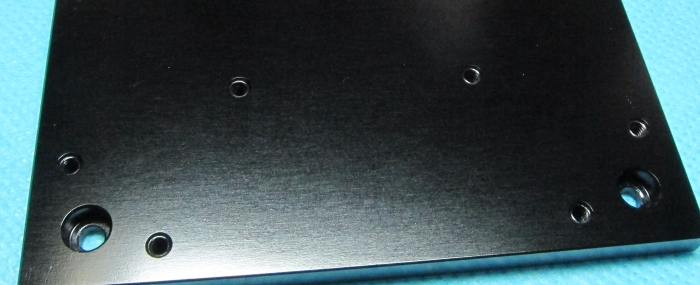
Black Anodizing on CNC Milling Part
The photo below shows the comparison of poor quality anodizing (left) and a good one (right). We can easily tell the difference based on color, surface quality. In general, the defective anodizing has a dirty gray, slightly brown color and a scratched surface.
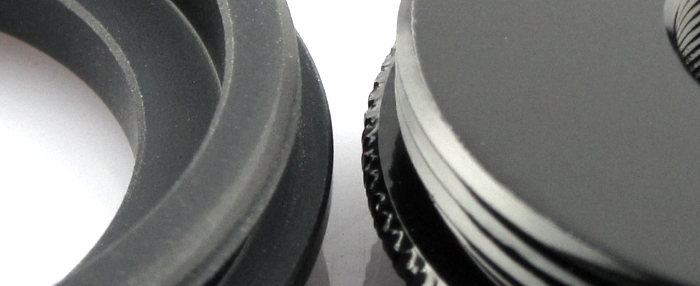
Different Surface Appearance after Anodizing
Teflon impregnating after anodizing
Instead of anodizing, we can also provide Teflon impregnation service. Our Teflon impregnation process produces a continuous layer of Teflon bonded to the anodized part surface. The Teflon layer offers significantly better lubricity and corrosion resistance.

Teflon Impregnated Aluminum Part with black hard anodizing
Send us email if you have any questions about surface treatment of the CNC machining aluminum parts. Also feel free to send us an RFQ for a free project review.