



Project Background & Customer Challenge
Recently, a customer designed a 0.8mm thin stainless steel component. During the initial prototyping phase, they utilized laser cutting to fabricate samples and verify dimensional functionality. Once the design was validated, the customer approached Apporo to evaluate building a stamping mold for mass production, aiming to achieve faster production speeds and more competitive unit pricing compared to laser cutting.
The part geometry was relatively straightforward, requiring only blanking (cut-to-shape) with no subsequent bending. However, the client had strong concerns regarding razor-sharp edges and micro-burrs along the sheared cutouts.
Shearing Characteristics of Thin Sheet Metal
As discussed in our previous case study (Fine Blanking vs. Conventional Stamping), thick metal sheets sheared during conventional stamping typically exhibit a significant roll-over radius on the cut edge alongside sharp burrs on the fracture zone. When transitioning to thin sheet metal (such as 0.8mm stainless steel), the roll-over zone is significantly reduced; however, the cut edges remain razor-sharp with noticeable micro-burrs.
Left untreated, these sharp edges pose safety hazards to assembly operators and can easily damage adjacent wires, hoses, or surrounding components in the final assembly.
Deburring and Surface Finishing Solutions
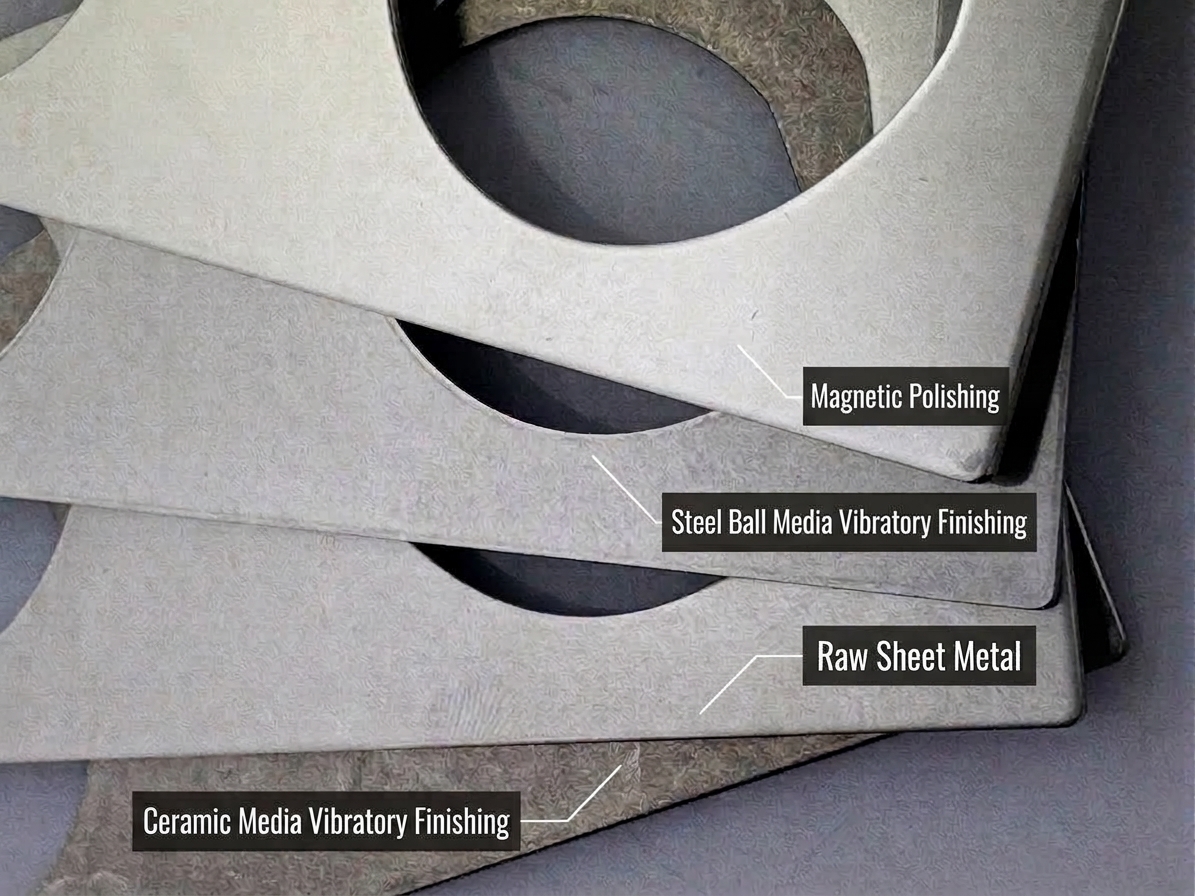
To eliminate edge hazards, protect delicate internal wiring, and achieve the required cosmetic texture, Apporo offered three specialized post-processing and surface finishing options:
| Finishing Method | Media Type | Surface Appearance | Deburring Capability & Features | Ideal Application |
|---|---|---|---|---|
| Ceramic Vibratory Finishing | Ceramic / Stone Media | Matte / Grey Finish | High stock removal rate; rapid edge radiusing and micro-burr elimination. | Internal structural components where functional deburring precedes appearance. |
| Steel Ball Vibratory Finishing | Steel Balls (Burnishing Media) | Smooth & Semi-Glossy | Combines edge rounding with mechanical burnishing to smooth surface peaks. | Cosmetic exterior parts requiring clean aesthetics and smooth touch. |
| Magnetic Pin Tumbling | SUS304 Magnetic Micro-Pins | Bright & Polished | Gentle deburring action; effortlessly accesses micro-holes, slots, and tight geometries without dimensional deformation. | Delicate cosmetic components, precision stamping parts, and electronic clips. |
Key Consideration: Preventing Distortion on 0.8mm Thin Parts
Finishing thin stamped components (under 1.0mm) requires careful control of tumbling parameters. Heavy ceramic media can cause thin flanges to bend or induce edge rolling. Furthermore, flat sheet parts are prone to nesting (parts sticking together via surface tension), which leads to uneven deburring. By fine-tuning the media-to-part ratio, vibration frequency, and compounding chemistry—or choosing magnetic tumbling for delicate profiles—Apporo ensures complete burr elimination without altering part flatness or critical tolerances.
Frequently Asked Questions (FAQ)
Will vibratory deburring alter the tight tolerances of stamped parts?
No. Vibratory and magnetic tumbling primarily target high-stress stress concentrations, micro-burrs, and sharp corners (edge breaking radius typically between R0.05mm and R0.1mm). Overall dimensional tolerances remain strictly intact when process cycles are properly controlled.
Which method is best for parts with complex interior cutouts and tiny holes?
Magnetic pin tumbling is ideal. Unlike stone media that can become lodged or trapped inside small holes, micro stainless steel pins (as small as 0.2mm–0.5mm) flow freely through intricate apertures and cavities to deburr without clogging.
From initial tooling design and mass stamping to selecting the optimal post-processing method, Apporo provides comprehensive manufacturing solutions tailored to our clients' functional and aesthetic requirements. If you have upcoming stamping projects or need guidance on surface finishing options, contact our engineering team today to discuss your project!